



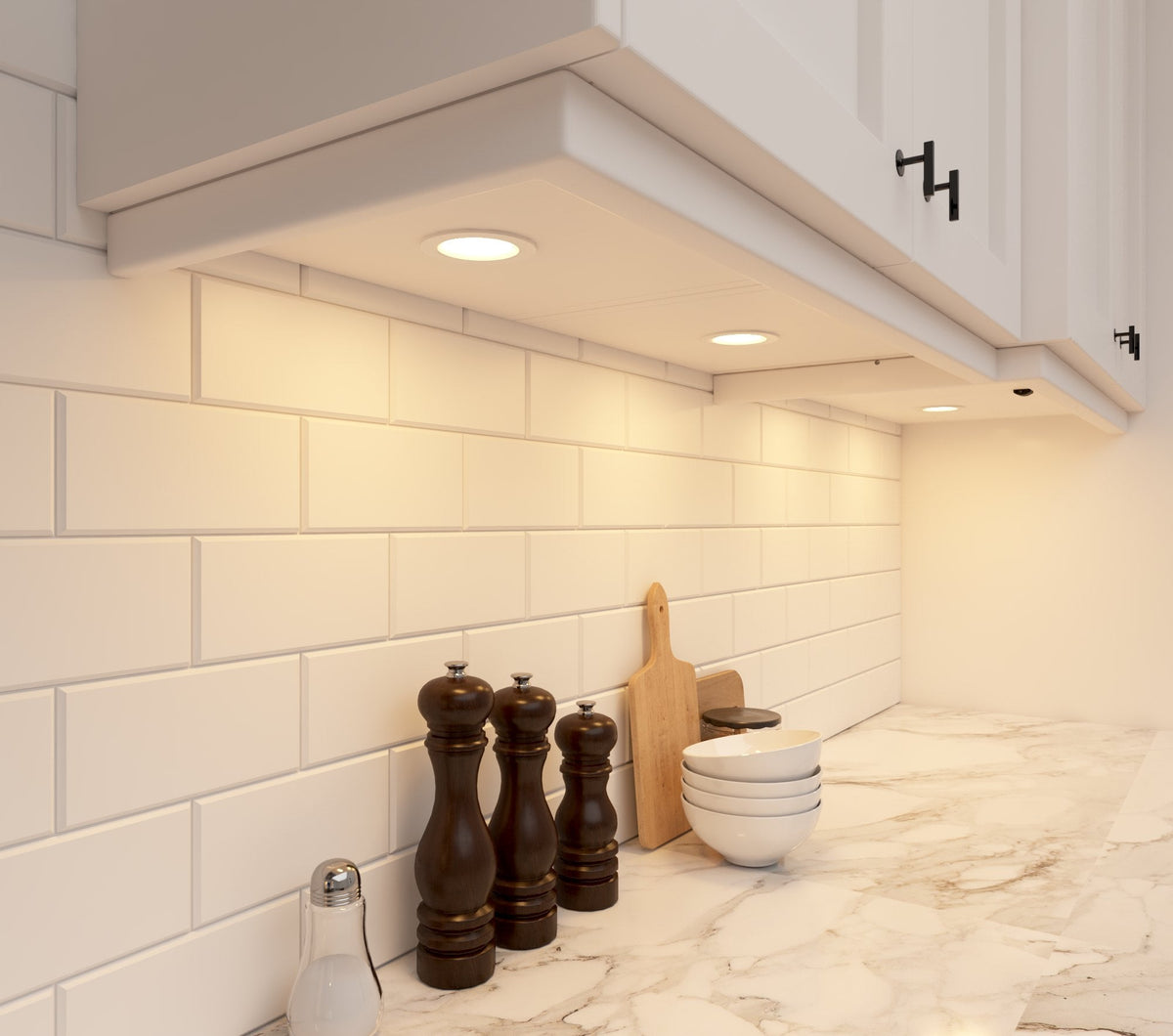
The INLIGHT IN-0102 puck light kit comes ready to plug in, with an in-line dimmer on the cord. That is the easiest setup. But if you would rather control the pucks from a wall dimmer, like the rest of your kitchen lighting, you can. The key is one extra part: a dimmable LED driver.
Why you need a driver
The IN-0102 pucks run on 12V DC. Your wall switch carries 120V AC. A universal dimmable 12V DC LED driver sits between them and acts as a bridge: 120V AC in from the wall dimmer, 12V DC out to the pucks, with the dimming passed through.
Which driver to choose
Look for a universal dimmable 12V DC LED driver. A 24-watt model is enough for this kit: each puck uses 2W, so a 3-pack draws 6W and a 6-pack draws 12W, leaving comfortable headroom.
Also check that the driver's listed dimmer compatibility includes the type of wall dimmer you plan to use.
These drivers usually have a plug on the input side, so you can either plug it into a switched outlet or direct-wire it to the wall switch. The output side connects to the lights.
How to connect it
The pucks connect to the kit's distribution block, so leave the puck connectors alone. Do not cut them. Instead, work on the kit's power lead:
- Cut the plug off the kit's power lead.
- Wire that bare end to the driver's 12V DC output, matching positive and negative.
- Plug the connector end of the lead into the distribution block.
- Plug the puck lights into the distribution block as usual.
- Connect the driver's input to the wall dimmer, either with its plug into a switched outlet or by direct wiring.

Now the wall dimmer controls the driver, and the driver powers and dims the pucks.
Before you start
- Unplug the kit and turn off power at the breaker before any wiring.
- Direct-wiring a driver to a wall switch should be done by a qualified electrician in line with local codes.
- Cutting the plug changes the kit from its original plug-in setup, so follow the driver maker's instructions closely.
Share:
How to Daisy-Chain Hardwired Under Cabinet Lights
How Many IN-0107 Puck Lights to Order: Single-Wire vs. Double-Wire